A gentleman's wardrobe is anchored by the integrity of his footwear. Investing in classic leather shoes requires moving beyond brand prestige to evaluate construction techniques, leather provenance, and last geometry. When chosen correctly, benchmark footwear provides decades of reliable wear, developing a rich patina that surpasses transient trend cycles.
Deciphering Construction: Goodyear Welts versus Blake Stitching
The foundation of any serious dress shoe lies in how the upper is attached to the sole. The Goodyear welt remains the benchmark of English and North American shoemaking. In this process, a strip of leather is stitched to both the upper and the insole rib, creating a cavity filled with granulated cork that molds to your foot over time. This architecture allows shoes to be resoled repeatedly without compromising the upper, providing superior water resistance and structural integrity across decades of consistent use.
Blake stitching offers a sleek, lower-profile alternative favoured by Italian ateliers. The stitch runs directly through the insole, upper, and outsole, eliminating the exterior welt for immediate flexibility and a trimmed silhouette. While Blake-stitched shoes feel light and break in quickly, they offer less moisture resistance and require specialized machinery to resole. For wet northern climates and daily commuting, prioritize Goodyear-welted models, reserving Blake-constructed footwear for lightweight seasonal loafers and razor-sharp evening dress shoes.
Leather Provenance: Full-Grain Calfskin and Shell Cordovan
Leather quality dictates how gracefully a shoe ages under regular wear. Full-grain French or German box calf, sourced from historic tanneries like Tanneries du Puy or Weinheimer, represents the gold standard for dress shoes. Because the outer epidermal layer remains untouched by sanding or artificial embossing, it retains its natural pore structure, breathability, and tensile strength. Premium calfskin develops subtle micro-creasing rather than deep cracks, absorbing shoe cream easily to maintain its suppleness.
Shell cordovan occupies an elevated tier in bespoke and heritage shoemaking. Sourced from the fibrous flat connective tissue beneath the hide of a horse rump, this vegetable-tanned leather is virtually non-porous and intensely durable. Cordovan does not crease in the traditional sense; instead, it develops soft, rolling waves across the vamp. Its natural oils produce a deep, self-buffing luster that withstands heavy rain and inclement weather, making it an exceptional choice for heirloom-grade bluchers, longwings, and penny loafers.

The Five Core Silhouettes for a Balanced Rotation
A functional shoe wardrobe requires distinct silhouettes to match varied trouser proportions and formality levels. The black cap-toe Oxford remains non-negotiable for dark worsted business suits and formal eveningwear, defined by its closed-lacing system where the quarters are stitched under the vamp. Adjacent to the Oxford is the dark brown or oxblood semi-brogue, which introduces decorative punching along the seams to bridge formal tailoring with flannel separates.
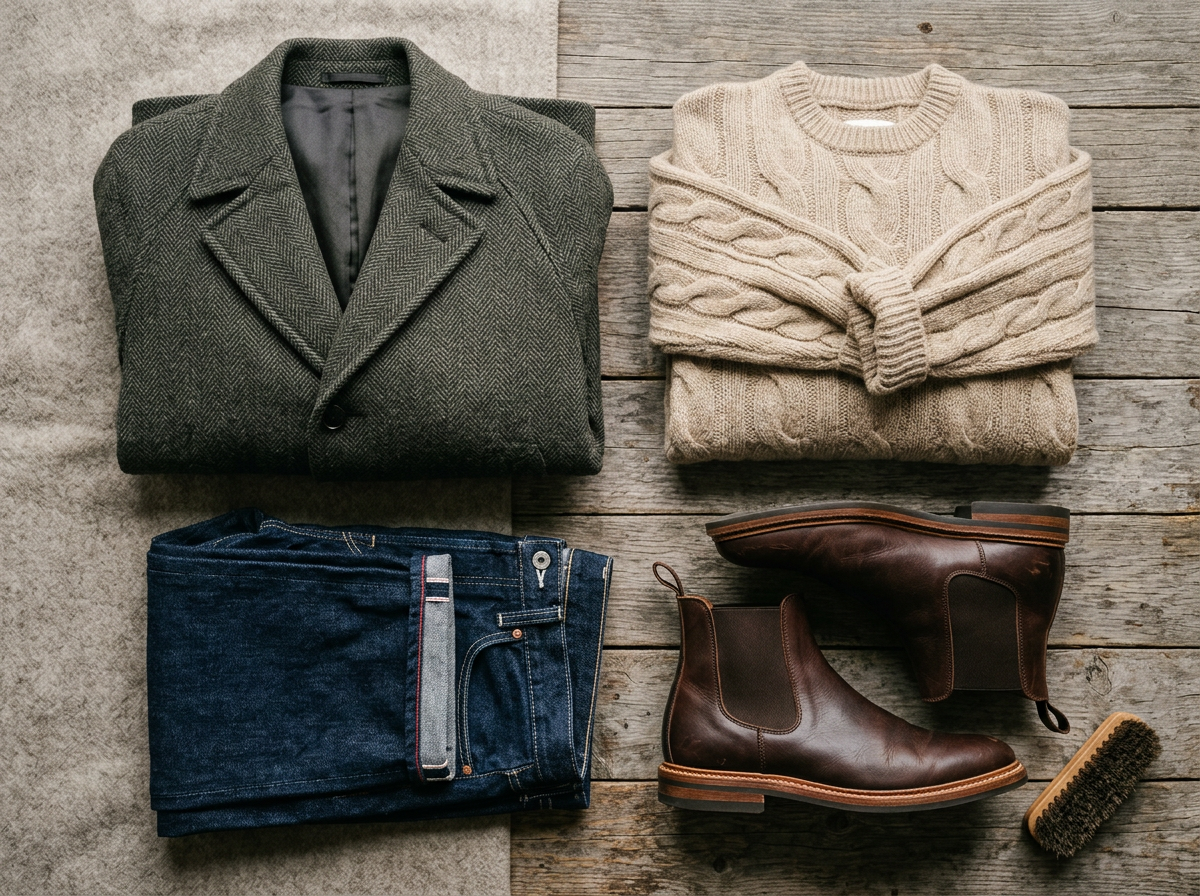
For smart-casual environments, the dark burgundy penny loafer and the calfskin Chelsea boot offer unmatched utility. Loafers complement cuff-less trousers and tailored linen, while a sleek Chelsea boot anchored by a chiseled toe sits cleanly beneath narrow hems. Rounding out the rotation is the Derby shoe, featuring an open-lacing system that accommodates higher insteps. Rendered in textured scotch-grain leather, a sturdy Derby harmonizes effortlessly with heavy twill, raw selvedge denim, and structured tweed jackets.
Evaluating Last Shapes and Proportional Balance
A shoe's last—the three-dimensional wooden or synthetic form around which the upper is shaped—determines fit, arch support, and visual footprint. Classic English lasts, such as those refined in Northamptonshire, feature balanced almond toes and generous ball measurements that suit traditional drape tailoring. Conversely, contemporary European lasts often incorporate elongated profiles or soft square chisels that demand tapered trouser cuffs with zero break to avoid catching the vamp.
When assessing fit, focus on the alignment of the ball of your foot with the widest point of the sole, alongside firm heel-cup retention with zero slippage. Leather will stretch marginally across the width over time, but the length between the heel and the toe box will remain fixed. Always fit footwear in the late afternoon when feet are naturally swollen, ensuring adequate space across the instep to prevent painful lace tension or premature vamp distortion.
Preservation Protocols and Developing the High-Gloss Patina
Extending the lifespan of fine footwear requires rigorous daily habits. Insert raw, unsanded aromatic cedar shoe trees immediately after removing your shoes to draw out internal moisture and smooth out vamp creasing. Never wear the same pair of leather shoes two days consecutively; allow a minimum of 24 hours of rest on trees to let the leather fibers dry and recover their shape naturally away from direct heat sources.
Execute a disciplined care routine every four to six weeks using a horsehair brush, a gentle nourishing cream, and a hard carnauba wax polish. Clean off surface dirt before massaging colored cream into the leather to replenish lost oils and restore depth of color. For a classic mirror finish on the stiffened toe cap and heel counter, apply minimal layers of wax with a damp cotton cloth using light, circular motions until the grain vanishes beneath a glass-like shine.